 Prague Jewish Quarter Tours
Golem of Prague
The Golem of Prague is the quarter's most famous story. A rabbi builds a man out of clay, brings him to life with the name of God, and sets him to guard the ghetto. This guide separates the tale from the record: what the legend says, when it was first written down, what the searches of the Old-New Synagogue attic actually found, and which Golem places you can still see in Josefov. It also lists the Prague Jewish Quarter tours that tell the story on the way. The bookable tours are compared on all Prague Jewish Quarter tours.
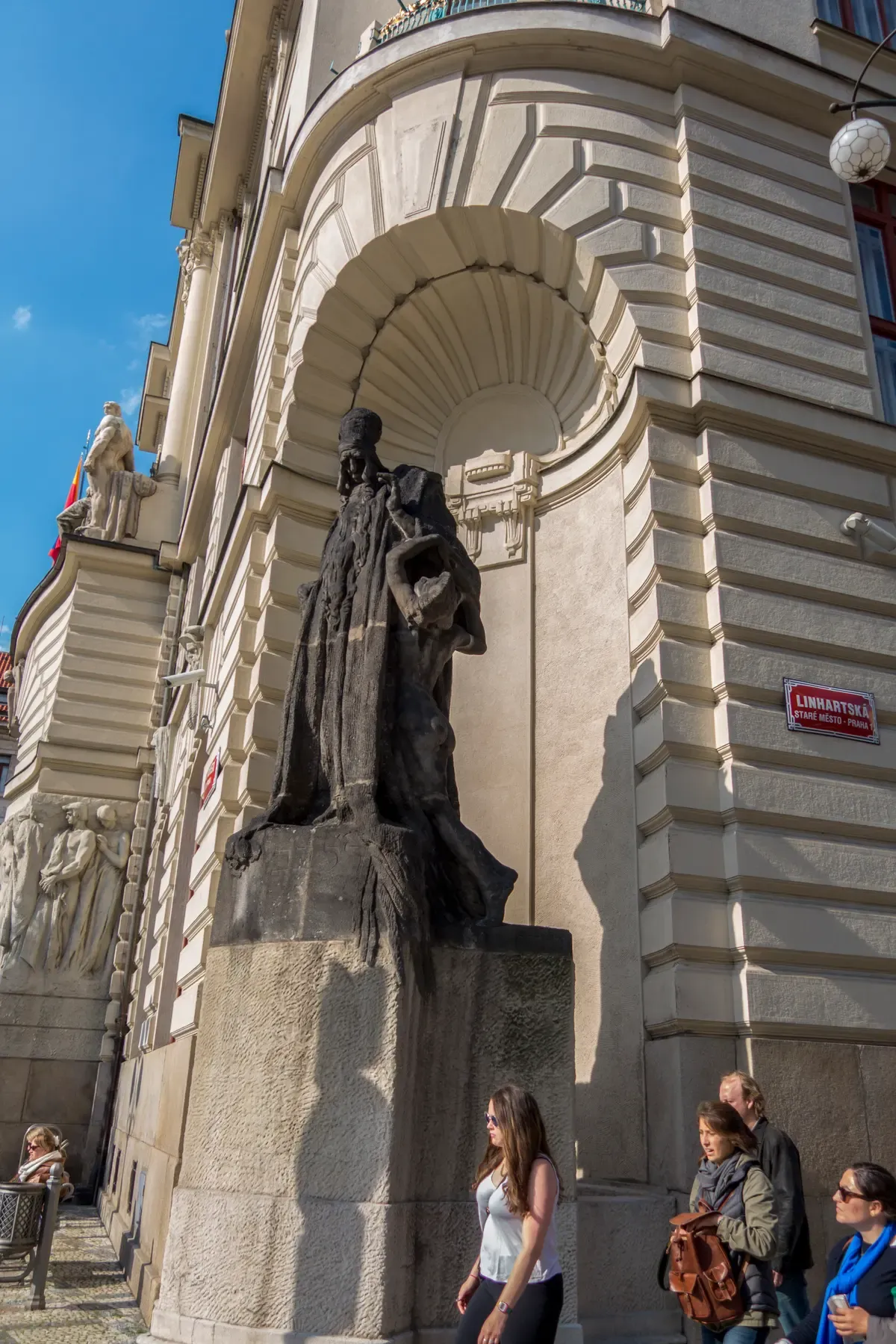
The statue of Rabbi Loew on the New Town Hall. Photo: Jerzy Strzelecki, CC BY-SA 3.0, via Wikimedia Commons
Quick answer The Golem in short
The Golem of Prague is a legend, and the first written versions appear between 1837 and 1847, long after Rabbi Loew died in 1609. The story makes Rabbi Loew create a clay man to defend the ghetto, animate him with a slip carrying God's name, and put him to sleep in the attic of the Old-New Synagogue. Two recorded searches of that attic, in 1883 and in August 2014, found no trace of a golem. You can still visit the synagogue, Rabbi Loew's grave and other Golem places in Josefov today.
Key takeaways
- Read the full tale in the legend of the Golem, from the clay to the aleph.
- See what the attic searches of 1883 and 2014 really found in the attic section.
- Hear the story told on the 2-Hour Jewish Quarter Tour for $28.60 per person, a 2-hour walk that includes the Golem legend.
- For a self-guided day, the Jewish Quarter Ticket at $51 covers the Old-New Synagogue and the cemetery where Rabbi Loew is buried.
The Legend of the Golem
The story as it is told in Prague today. It is a legend, and no source from Rabbi Loew's own century records it.
A Man of Clay to Defend the Ghetto
In the legend, Rabbi Loew, the scholar known as the Maharal, made a golem out of clay to defend the Jewish ghetto during the reign of Rudolf II. The golem was a man-shaped figure brought to life and set to work protecting the community against its enemies.
The animation came through a shem, a slip of parchment with the name of God on it, placed in the golem's head or mouth. As long as the shem stayed in place, the golem moved, worked and guarded.
The Name of God and the Letter Aleph
The power that moved the golem was the name of God, written on the slip inside it. That power could also be taken back. Erasing one letter does the work: emet is the Hebrew word for truth, and removing the aleph leaves met, the word for dead. With that change the golem switched off.
In the story the golem's body is then placed in the attic of the Old-New Synagogue, where legend says it remains. The Jewish Town Hall, built next door under Mordechai Maisel, is part of the setting.
What the Golem Is Not
It is worth stating plainly what the record shows. Rabbi Loew never mentioned a golem in his own writings, and no Prague source from the 16th, 17th or 18th century does either. Historians generally treat the story as a German literary invention of the early 19th century, attached later to the name of the city's most revered rabbi.
That does not make the legend worthless. It says something about how the community remembered its defenders and its fears. The 1920 film The Golem showed the medieval quarter as cramped and angular. Treat the tale as the literature it is, and visit the real places behind it.
Sources: Jewish Museum in Prague, Jewish Community of Prague synagogues, Prague City Tourism
Where the Story Comes From
Sources, dates and the historical Rabbi Loew, including the disagreement over the year he was born.
When the Story Was First Written Down
The earliest written Prague Golem accounts date to 1837 to 1847, by German-Jewish writers. Before that, no Prague source from the 16th to the 18th century mentions a golem.
The version most people know arrived later still. Rabbi Yudl Rosenberg published his 1909 version of the tale, and that book is generally regarded as a literary hoax. So the Golem of Prague story is a literary tradition, while the man it is attached to died in 1609. When a guide tells the tale in Josefov, they are retelling 19th and 20th-century literature.
Who Rabbi Loew Was
Rabbi Loew, also called the Maharal of Prague and Judah Loew ben Bezalel, was a real and famous scholar. His grave in the Old Jewish Cemetery is the most visited there, and his death date is firmly recorded as 1609.
His birth year is disputed. One Wikipedia article lists him as living 1512 to 1609, while the dedicated article on Judah Loew ben Bezalel gives his birth as about 1524 and his death as 17 September 1609. Both dates circulate.
The golem appears nowhere in his writings, which is one of the strongest arguments that the legend was attached to his name long after his death.
How the Legend Took Over the Quarter
Once the 19th-century writers had attached the golem to Rabbi Loew, the story grew a geography. The attic of the Old-New Synagogue became the golem's resting place. The rabbi's seat to the right of the altar has stayed empty since his death.
The legend now shapes the visit more than most visitors expect. At least one of the Prague Jewish Quarter tours names the Golem legend in its listing. The statue of Rabbi Loew by the sculptor Šaloun stands at the New City Hall, and it is a statue of the rabbi, not of a golem.
The Attic of the Old-New Synagogue
The golem's legendary resting place: the two searches and the question of going up.
The Legend and the Building
The legend says the golem's body lies in the attic of the Old-New Synagogue, where Rabbi Loew left it after switching it off.
The synagogue itself is real and very old. It dates from the last third of the 13th century, with Wikipedia dating its completion to 1270, and it is Europe's oldest extant active synagogue, in use for over 700 years apart from 1942 to 1945. The hall below has a double nave with six vaulted bays, five-rib vaults and twelve lancet windows. Rabbi Loew's seat to the right of the altar has stayed empty since his death. All of that you can see. The attic you cannot, and that is where the story lives.
Two Searches, No Golem
The attic has been entered and checked twice, and both times the searchers came down empty-handed.
The first check came in 1883, around the renovation of the synagogue, and found no evidence of the Golem. The second came much later: an attic exploration in August 2014 also found no trace of a golem. Both searches had the same result.
Report these honestly and the legend loses nothing. The searches are now part of the story themselves, and they are the best answer to anyone asking whether the golem of Prague is real. The body that legend places in the attic has never been found, because there is nothing to find. What remains is a 13th-century building, an empty seat, and one of Europe's great pieces of Jewish folklore.
Can You Go Up?
Not as far as the visitor information shows. It does not offer access to the attic. Entry to the synagogue itself has changed: separate Old-New Synagogue tickets have not been sold since 1 January 2024, and entry now runs through the Jewish Town circuit. Tickets can be bought online.
The synagogue is closed on Saturdays and Jewish holidays. In 2026 it opens 9:00 to 17:00 from 2 January to 31 March, and the season listing shows 9:00 to 18:00 daily in the current season. It usually closes an hour before Shabbat begins. It pairs naturally with the Old Jewish Cemetery guide next door, where Rabbi Loew's grave stands. For the full visit details, opening hours and the ticket situation, see the dedicated Old-New Synagogue guide.
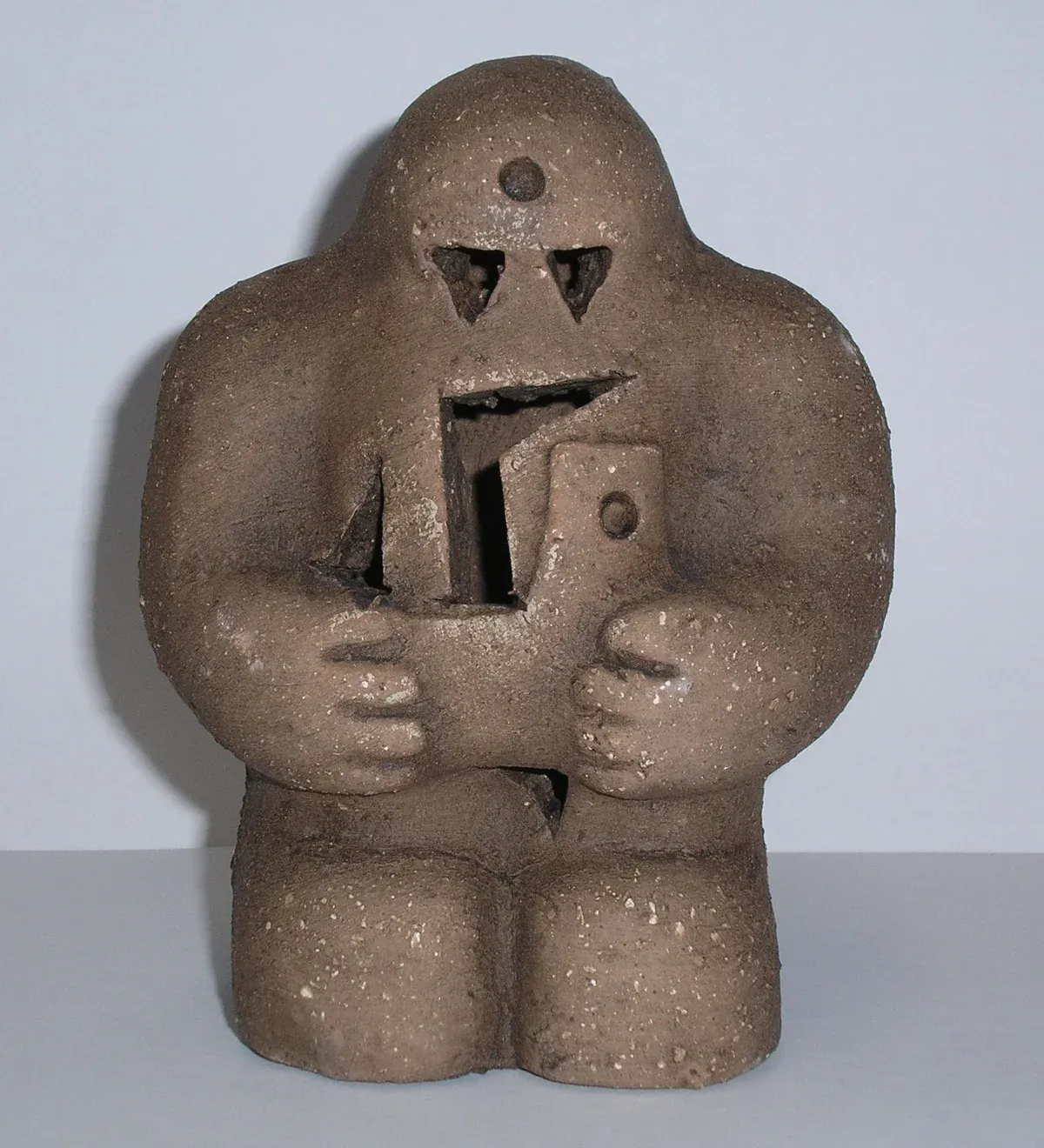
A reproduction of the Prague Golem figure. Photo: user Thander, Public domain, via Wikimedia Commons
Golem Places in Josefov
Where the legend touches the quarter today, and which tours tell the story. The figures come from the Jewish Museum, the Jewish Community and the tour listings.
Four Places to Stand
The table below compares the places in Josefov and beyond that link to the Golem legend, with how each is entered. Nothing here contains a golem. Each place links to the story through Rabbi Loew, through the attic, or through the memory of the quarter he served.
| Place | What links it to the Golem | Entry |
|---|---|---|
| Old-New Synagogue | Legend puts the golem's body in the attic. Rabbi Loew's seat has stayed empty since 1609. | Through the Jewish Town circuit, no separate tickets since 1 January 2024. Closed Saturdays and Jewish holidays. |
| Old Jewish Cemetery | Rabbi Loew (d. 1609) has the most visited grave, tied to the legend. In use from 1439 into the 1780s, with more than 12,000 tombstones. | Via the Jewish Museum circuit ticket, entering through the Pinkas Synagogue at Široká 3. Men cover their heads. A visit takes about 30 minutes. |
| Jewish Town Hall | Built under Mordechai Maisel, with sources dating it to 1577 or 1586, next to the Old-New Synagogue. | Closed to the public. Its lower clock has Hebrew numerals and runs counterclockwise. |
| Rabbi Loew statue, New City Hall | Šaloun's statue of the rabbi, not of a golem. | Outdoor public monument, ticket not stated. |
The Grave Itself
Rabbi Loew's Renaissance tomb in the Old Jewish Cemetery draws pilgrims who leave written prayer requests, a practice that continues regardless of what anyone believes about golems. The cemetery holds more than 12,000 tombstones stacked in layers, with as many as twelve burial layers in some places, and it was in use from 1439 until 1786 or 1787 depending on the source. The oldest stone, from 1439, belongs to rabbi Avigdor Kara.
Visitors walk only the marked route, men cover their heads, and nothing may be removed. A dog is buried there too. For prices, the circuit and practical details, see the dedicated Old Jewish Cemetery page. The grave is the single most Golem-charged stop in Josefov, and it needs no attic to make its point.
Tours That Tell the Legend
The clearest way to hear the story in place is a guided walk. The 2-Hour Old Town and Jewish Quarter Tour from Guides&Tours lists the Golem legend in its description: 2 hours from the Old Town Hall through Old Town Square and the Jewish Town, up to 5 people, at $28.60 per person, wheelchair accessible, with 504 reviews at 4.9. It does not include synagogue entry.
If you want to stand inside the synagogue and at the grave, the Jewish Quarter Tour with Tickets at $74 per person covers a 2.5-hour walk with entry to four synagogues and the Old Jewish Cemetery included, at 4.7 from 4,468 reviews. For a low-cost exterior option, the Old Town and Jewish Quarter Walking Tour at $22 per person covers the quarter from the outside in 1.5 hours. Every tour here has free cancellation 24 hours ahead.
Golem of Prague: Questions and Answers
What is the story of the Golem of Prague?
Rabbi Loew made a clay golem to defend the ghetto during Rudolf II's reign, animated it with a shem, a slip carrying God's name, and switched it off by changing emet (truth) to met (dead). The tale is 19th-century literature, first written down between 1837 and 1847. You can hear it told on the 2-Hour Jewish Quarter Tour in the lanes where it is set.
Where is the Golem of Prague now?
The legend places the golem's body in the attic of the Old-New Synagogue, where it is said to remain. The visitor information does not offer access to the attic, and entry to the synagogue runs through the Jewish Town circuit, since separate tickets ended on 1 January 2024. The building and its history are covered in the Old-New Synagogue guide.
Is the Golem of Prague true?
No. Historians generally call the story a German literary invention of the early 19th century, and the 1909 version by Rabbi Yudl Rosenberg is regarded as a literary hoax. Rabbi Loew never mentioned a golem in his writings. Two attic searches, in 1883 and August 2014, found nothing. What is true is the man, whose most visited grave sits in the Old Jewish Cemetery.
Is Frankenstein based on the Golem of Prague?
No source behind this guide links Frankenstein to the Prague Golem, so the guide makes no claim either way. The Golem legend itself is laid out in the legend section of this guide.
Can you see the golem in the Old-New Synagogue attic?
The visitor information does not offer access to the attic. The attic was explored during the 1883 renovation and again in August 2014, and both times no trace of a golem was found. Visitors see the hall below, with its five-rib vaults and the empty seat of Rabbi Loew. Details of the visit are in the Old-New Synagogue guide.
Where is Rabbi Loew buried?
In the Old Jewish Cemetery in Josefov, in use from 1439 until 1786 or 1787, where his Renaissance tomb is the most visited grave and pilgrims leave written prayer requests. Men cover their heads, and entry runs through the Jewish Museum circuit. Practical detail is in the Old Jewish Cemetery guide.