 Prague Jewish Quarter Tours
Old Jewish Cemetery in Prague: Graves, Stones and How to Visit
The Old Jewish Cemetery in Prague's Josefov quarter holds more than 12,000 tombstones stacked in up to 10-12 layers, and it was used from 1439 until burials were banned in the 1780s. This guide covers the entrance, the ticket, the head-covering rule, the hours and closures, and the graves worth finding, from Rabbi Loew to David Gans. The bookable tours are compared on Jewish Quarter tours in Prague.
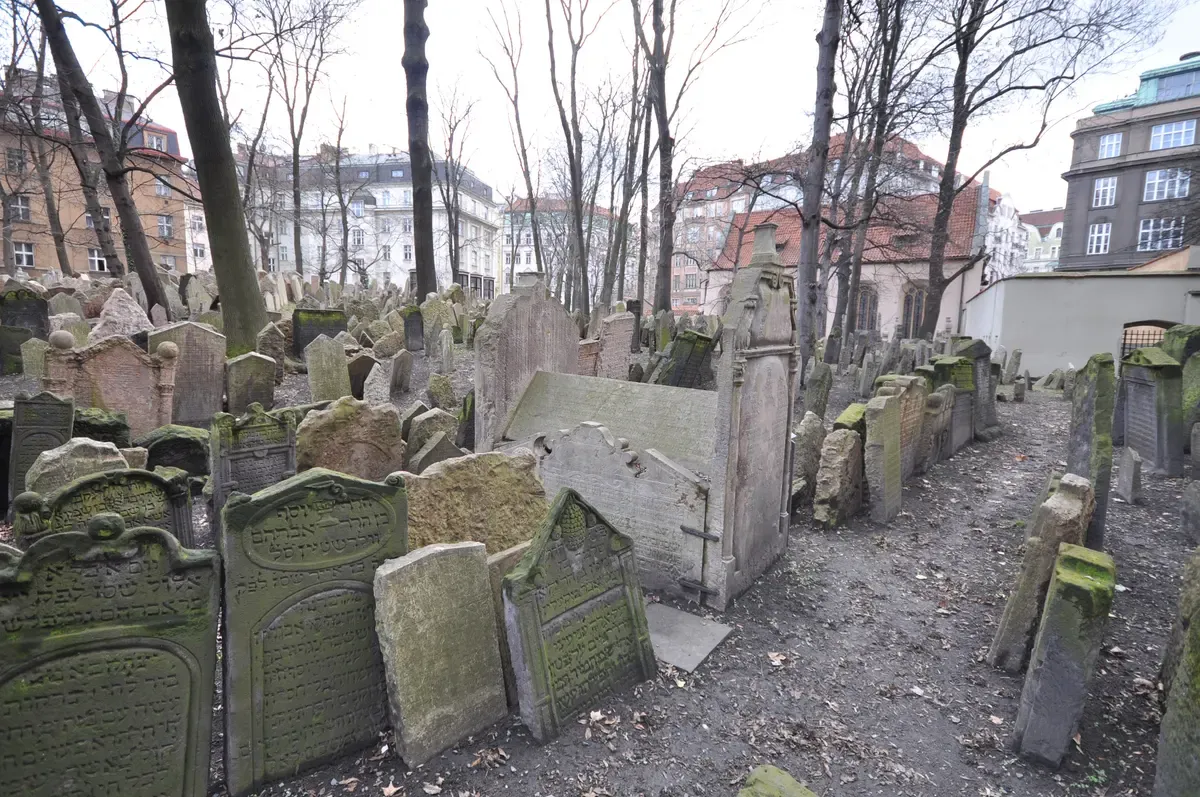
Crowded gravestones in the Old Jewish Cemetery in Josefov. Photo: Jorge Láscar from Australia, CC BY 2.0, via Wikimedia Commons
Quick answer The short answer
The Old Jewish Cemetery Prague was in use from 1439 until 1786 or 1787, depending on the source, and holds more than 12,000 tombstones in up to twelve burial layers. You enter it through the Pinkas Synagogue at Široká 3 and leave on U Starého hřbitova street. It is not a standalone sight: admission comes with the Jewish Museum circuit ticket, and men must cover their heads. A typical visit takes about 30 minutes.
Key takeaways
- Entry is via the Pinkas Synagogue at Široká 3, and the ticket also covers the other museum sites in Josefov.
- The Jewish Quarter Tour with Tickets includes cemetery entry in a 2.5-hour guided walk costing $74 per person.
- Do not want a guide? The Jewish Quarter Ticket is a self-guided option at $51 per person, valid for 1 day.
- The graves that matter most are Rabbi Loew, Mordecai Maisel and David Gans, all covered in the Graves to Find section below.
Visiting the Cemetery
The cemetery sits behind the Pinkas Synagogue in the middle of Josefov, a few minutes on foot from Old Town Square. You cannot buy a ticket for it alone, so plan it as part of a longer circuit of the Jewish Town.
Entrance, Ticket and Rules
Entry to the cemetery runs through the Pinkas Synagogue at Široká 3, and the marked route brings you out on U Starého hřbitova street. There is no separate cemetery ticket. Admission comes with the Jewish Quarter Ticket, the museum's unified ticket, which covers the currently open sites in the circuit: the Maisel, Pinkas, Spanish and Old-New Synagogues plus this cemetery. Children up to 6 enter free, and each site can be entered only once per ticket, so time your route. Individual and family tickets stay valid for three opening days, while group tickets for six or more people are valid only on the day of issue. Men must cover their heads on entering, with their own cap or a borrowed one. Visitors may walk only the marked route, bags over 30 litres are refused, and security checks apply at entry. Wheelchair access is partial and comes from U Starého hřbitova street at the exit side, not from the Pinkas entrance. The table pulls these details together.
The cemetery closes with the museum: every Saturday and on Jewish holidays, plus the published holiday dates. Temporary changes are announced at least 24 hours ahead on the museum website.
| What | Detail |
|---|---|
| Entrance | Through the Pinkas Synagogue, Široká 3 |
| Exit | Onto U Starého hřbitova street |
| Ticket | Sold only as part of the Jewish Museum circuit ticket, the Jewish Quarter Ticket, not on its own |
| Hours | Open daily except Saturdays and Jewish holidays, 9:00 opening, closing between 16:30 and 19:00 depending on the season |
| Closed days | Saturdays and Jewish holidays, with the museum's published closed dates |
| Head covering | Required for men, own or borrowed |
| Route | Marked route only, Pinkas Synagogue in, U Starého hřbitova street out |
| Accessibility | Partial wheelchair access from U Starého hřbitova street only |
| Getting there | Staroměstská metro station (Line A), trams 17 and 18, a 3-minute walk |
How Long to Allow and When It Is Quiet
The cemetery is one stop on the museum circuit, which is enough to walk the marked loop and stop at the best-known stones. Budget the full 2 to 3 hours the museum suggests for the complete circuit if you add the synagogues. Tickets stop being sold 30 minutes before closing, and staff start moving visitors out 10 minutes before closing, so a late-afternoon arrival cuts the visit short.
For quiet, the museum itself advises avoiding the 11:00 to 15:00 peak and says mornings and late afternoons are much quieter. First thing in the morning is the better bet. If a guide would help you read the stones, the Jewish Quarter and Museum Tour is a private 3-hour walk with a guide certified by the Jewish Museum, and entry is included in its price from $81 per person.
- About 30 minutes for the cemetery alone, 2-3 hours for the full circuit
- Mornings and late afternoons are quieter than 11:00-15:00
- Last ticket sales 30 minutes before closing, last exit 10 minutes before
- Closed every Saturday and on Jewish holidays
Sources: Jewish Museum in Prague, Jewish Community of Prague synagogues, Prague City Tourism
Graves to Find
More than 12,000 stones crowd this ground, and the names on them read like a history of the Prague community. These are the graves the marked route is built around, and each stone carries Hebrew inscriptions with symbols showing the person's trade, lineage and character.
Rabbi Loew
Rabbi Loew, also called the Maharal, died in 1609 and has the most visited grave in the cemetery. His Renaissance tomb draws pilgrims who leave written prayer requests tucked around it. Loew is linked to the legend of the Golem, the clay creature he is said to have made to protect the ghetto, a story told on its own page about the Golem of Prague.
His statutes for the Prague Burial Society became a model for Ashkenazi burial societies across Europe. Sources disagree on his birth year, with 1512 and about 1524 both given, but the death in 1609 is fixed.
- Died 1609
- Renaissance tomb, the cemetery's most visited
- Linked to the Golem legend
Mordecai Maisel
Mordecai Maisel, 1528 to 1601, was the mayor of the Jewish Town and is buried here. The Maisel Synagogue was built for him between 1590 and 1592, and the Jewish Town Hall was built under him.
- Lived 1528-1601
- Mayor of the Jewish Town
- Built the Maisel Synagogue, 1590-1592
David Gans
David Gans was born in Lippstadt in 1541 and died in Prague on 25 August 1613. He was a chronicler and astronomer, an associate of Tycho Brahe and Kepler, and the first influential Jewish writer to reconcile Copernicanism. His chronicle Tzemach David, published in 1592, covers Jewish and general history in two parts.
Brahe asked him to translate the Alfonsine Tables from Hebrew into German. His gravestone is one of the easiest to spot: it carries a Star of David, alluding to his book Magen David, and a goose, because gans means goose in German and Yiddish.
- Lived 1541-1613
- Astronomer and chronicler, worked with Tycho Brahe and Kepler
- Stone shows a Star of David and a goose
Avigdor Kara
Avigdor Kara holds the oldest identified grave in the cemetery, with a stone dating to 1439, the very start of the burial record here. He was chief rabbi of Prague and a Kabbalist who met King Wenceslaus IV. He wrote an elegy on the 1389 Easter pogrom, in which an estimated 3,000 Prague Jews were murdered.
The elegy, Et Kol Hatela'ah, is still part of Yom Kippur services. He is called the last Ashkenazi payyetan, a composer of liturgical poetry, with 8 of his piyyutim surviving. Finding his stone means standing at the earliest dated point of the burial record.
- Died 1439
- Oldest identified grave in the cemetery
- Wrote an elegy on the 1389 pogrom
David Oppenheim
Chief Rabbi David Oppenheim died in 1736. His library is kept at Oxford's Bodleian Library.
- Died 1736
- Chief Rabbi
- His library sits in Oxford's Bodleian
Mordecai Katz and Joseph Solomon Delmedigo
Mordecai Katz died in 1592. Joseph Solomon Delmedigo lived from 1591 to 1655. A pair of blessing hands on a stone marks a Cohen, a descendant of priests, and a pitcher marks a Levite, so check the carvings as you go.
- Mordecai Katz, died 1592
- Joseph Solomon Delmedigo, 1591-1655
- Blessing hands mark a Cohen, a pitcher marks a Levite
Reading the Stones
The cemetery is a graveyard of layers, and the stones themselves carry a code you can learn in a few minutes.
More Stones Than Graves
The museum counts more than 12,000 tombstones on the site, and some researchers suggest the graves were stacked in up to ten layers, with some places showing as many as twelve. Graves were stacked in layers, which is why the stones lean and jostle at odd angles today.
The oldest identified stone dates to 1439 and belongs to Avigdor Kara, the chief rabbi and Kabbalist who died that year. He wrote an elegy on the 1389 Passover pogrom that is still part of Yom Kippur services. Early stones are dark sandstone, while later ones are marble with ornate reliefs.
The stones carry Hebrew inscriptions, and the carved symbols stand for profession, lineage and character, so a trained eye can read a life from the relief alone. A guide makes this code legible, which is one of the strongest arguments for a Prague Jewish Quarter tour.
The Symbols and What They Mean
Carved signs on the stones are not decoration. They mark the profession, lineage and character of the people below, and sometimes their surnames. Here are the meanings the sources give, so you can decode stones as you walk the marked route.
| Symbol | Meaning |
|---|---|
| Pair of blessing hands | Marks a Cohen, a descendant of priests |
| Pitcher | Marks a Levite |
| Crown | Stands for wisdom |
| Grapes or a pomegranate | Stands for abundance |
| Lion | Matches the surname Loew |
| Deer | Matches the surname Hirsch |
| Star of David and a goose | Marks David Gans, because gans means goose in German and Yiddish |
| Goose and star pair on his stone | The star alludes to his book Magen David |
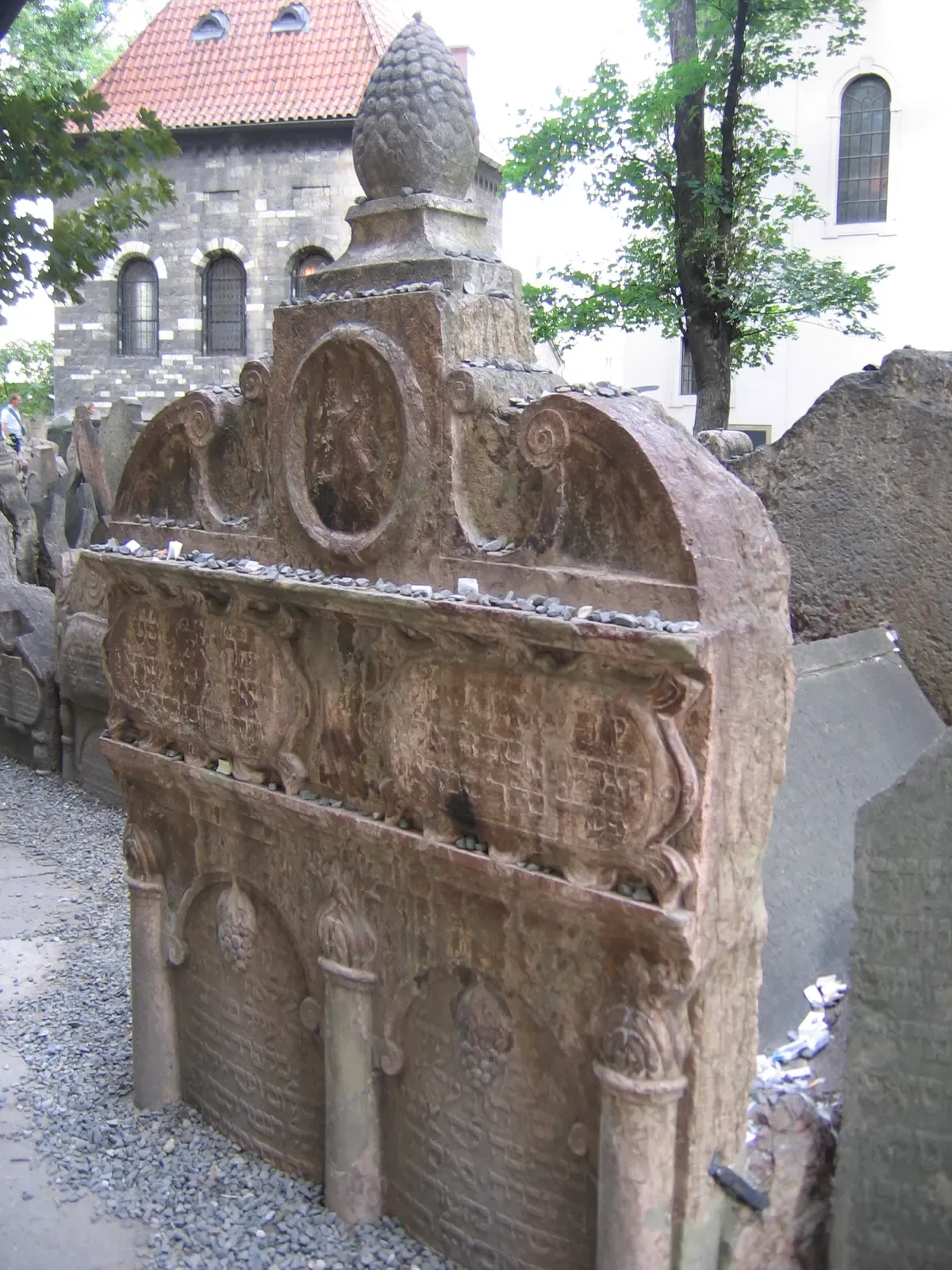
The tomb of Rabbi Loew in the Old Jewish Cemetery. Photo: Postdlf, CC BY-SA 3.0, via Wikimedia Commons
Centuries of Burials
The cemetery served the Prague Jewish community from the 15th century until an imperial ban ended burials inside the city walls.
How Long It Was in Use
The museum says the cemetery was in use between 1439 and 1787, while Wikipedia describes use from the first half of the 15th century until 1786, with the last burial in 1787. The honest reading is that the two sources differ on the exact end date: one says 1786, the other 1787, and the last burial is placed in 1787 after Joseph II banned burials inside the city walls. Either way, burials ran from 1439 into the 1780s.
It survived the demolition that reshaped Josefov between 1893 and 1913, when most of the former ghetto's buildings were torn down and only six synagogues, the cemetery and the Town Hall were spared. The key years are below.
| Year | What happened |
|---|---|
| 1439 | Death of Avigdor Kara, whose stone is the oldest identified grave |
| 1609 | Death of Rabbi Loew, whose grave is the most visited |
| 1613 | Death of David Gans, the chronicler and associate of Tycho Brahe |
| 1736 | Death of Chief Rabbi David Oppenheim |
| 1786-1787 | Sources conflict on the end of use, the last burial is dated 1787 after Joseph II's ban |
| 1893-1913 | Slum clearance of Josefov, the cemetery was one of the few sites spared |
Seeing It With a Guide
Several Jewish Quarter tours in Prague walk the cemetery with a licensed guide, since only guides accredited in the Czech Republic may guide inside the museum sites.
Tours That Enter the Cemetery
The clearest option on entry is Prague: Jewish Quarter Walking Tour with Admission Tickets at $74 per person. It lasts 2.5 hours and includes entry to the Maisel, Pinkas, Spanish and Old-New synagogues plus the Old Jewish Cemetery.
The private Prague: Jewish Quarter and Museum Guided Tour costs $81 per person with a 25 euro entrance fee included and runs 3 hours with a Jewish Museum certified guide. For a private option with hotel pick-up, Prague: Synagogues and Jewish Quarter Private Walking Tour is $189 per group of up to 2 for 2.5 hours with admission included, and Prague's Jewish Quarter Private Tour is $165.89 per person for 3 hours with the entrance fee included.
Inside Jewish Prague: A Journey Through Time at $68.64 per person walks Josefov's synagogues and the cemetery over 3 hours, but the listing does not say admission is covered. On the self-guided side, the museum ticket is sold as the Jewish Quarter Ticket and on Prague: Jewish Quarter Ticket with Optional Audio Guide at $51 per person, valid 1 day with a 20-minute introduction. All listings here offer free cancellation 24 hours ahead.
Do and Don't at the Cemetery
Do
- Do cover your head if you are a man, because the visitor rules require men to cover their heads on entering, with your own cap or a borrowed one.
- Do stay on the marked route, because visitors may walk only the marked path through the graves.
- Do come early or late in the day, because the museum advises avoiding the 11:00-15:00 peak, when mornings and late afternoons are much quieter.
- Do leave written prayer requests at Rabbi Loew's Renaissance tomb, because the museum notes pilgrims leave them there.
- Do allow about 30 minutes, because that is the museum's own estimate for a cemetery visit, and the ticket lets you enter each site once.
Don't
- Don't take anything from the cemetery, because nothing may be removed and even a dog is buried among the graves.
- Don't bring bags over 30 litres, because they are refused at the entrance and the museum has no luggage storage.
- Don't bring food, drinks or a dog, because food, drinks and smoking are banned in all visitor areas and dogs are banned except certified assistance dogs.
- Don't count on full wheelchair access, because partial access exists only from U Starého hřbitova street, at the exit.
Old Jewish Cemetery Questions
Can you visit the Old Jewish Cemetery in Prague?
Yes. It is part of the Jewish Museum circuit and opens daily except Saturdays and Jewish holidays. You enter through the Pinkas Synagogue at Široká 3 with the Jewish Quarter Ticket, and each site can be entered once per ticket.
Who is buried in the Old Jewish Cemetery?
The best known graves are Rabbi Loew, who died in 1609, the mayor Mordecai Maisel, the chronicler David Gans, Mordecai Katz and Chief Rabbi David Oppenheim. The graves section lists them with their dates.
How many people are buried there?
The museum counts more than 12,000 tombstones, with graves stacked in up to ten layers and in some places as many as twelve, so the number of people buried is far higher. The layout is explained in the section on reading the stones.
Why are the stones so crowded and tilted?
Graves were layered on top of each other, which is why the stones sit so close together at odd angles. The history section lays out the timeline.
Is the Old Jewish Cemetery the oldest Jewish cemetery in the world?
The sources do not make that claim. They describe it as in use from 1439, so it should not be called the oldest in the world. What they confirm is more than 12,000 tombstones stacked in up to 10-12 layers.
Do men need a head covering at the cemetery?
Yes. The museum's visitor rules state that men must cover their heads on entering, either with their own covering or a borrowed one. The same rules require visitors to stay on the marked route, per the cemetery rules section.