 Prague Jewish Quarter Tours
Jewish Quarter Prague: a Guide to Josefov
The Jewish Quarter Prague is Josefov, the small district of the Old Town where the medieval ghetto stood. Six synagogues, the Old Jewish Cemetery and the Jewish Town Hall survive there today. This guide covers what to see in each building, how the ghetto became Josefov, and the practical rules that apply inside the sites. For comparing guided walks and tickets, see Prague Jewish Quarter tours on the homepage.
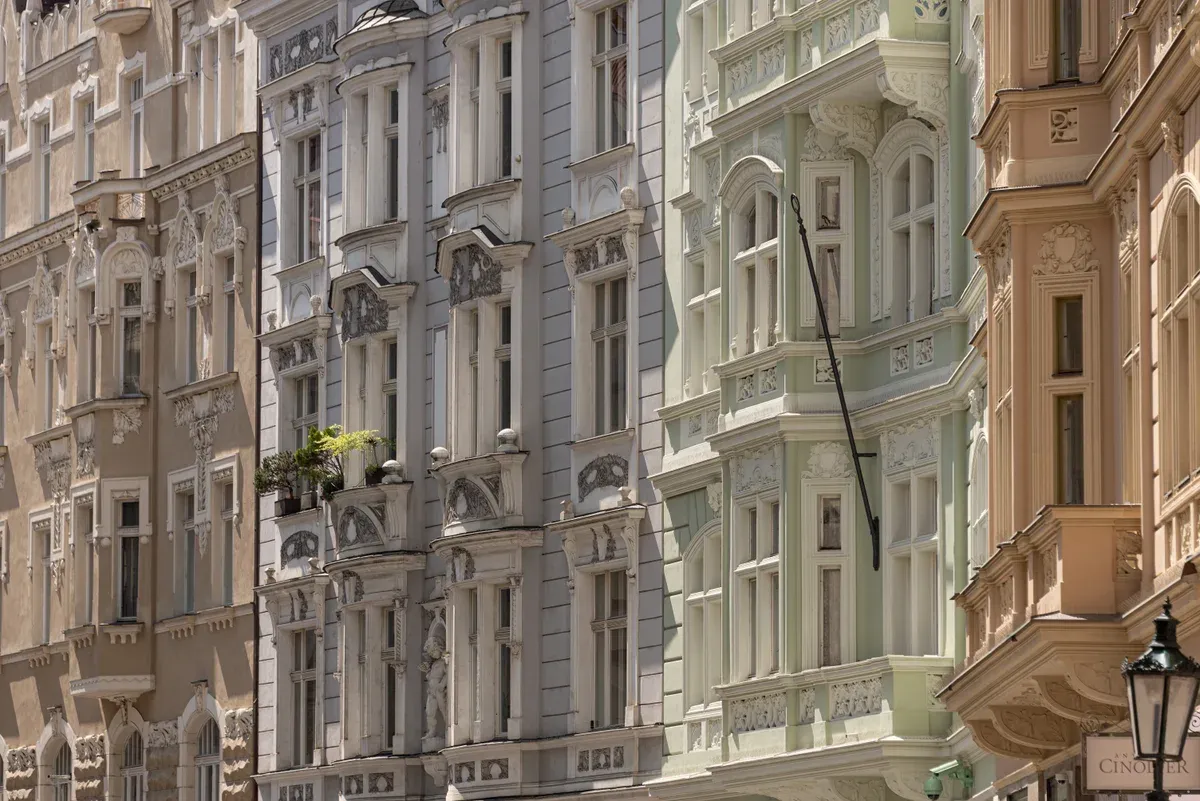
Facades along Maiselova street in the Jewish Quarter. Photo: Giorgio Galeotti, CC BY 4.0, via Wikimedia Commons
Quick answer Josefov at a glance
The Jewish Quarter Prague, called Josefov, is a district of the Old Town holding six synagogues, the Old Jewish Cemetery and the Jewish Town Hall, with about 977 residents counted in 2021. The Jewish Museum puts a complete visit at roughly 2-3 hours, and one ticket covers the sites in the circuit. Staroměstská metro station on Line A is a 3-minute walk away.
Key takeaways
- The Old-New Synagogue, in use for over 700 years, is Europe's oldest working synagogue. See the Old New Synagogue guide.
- A full circuit visit takes about 2-3 hours and is covered by the Jewish Quarter Ticket, listed from $51 per person.
- The Pinkas Synagogue walls carry the names of Bohemian and Moravian Shoah victims, counted as 77,297 by Wikipedia and as nearly 80,000 by the museum. Details in the Pinkas Synagogue guide.
- Every site closes on Saturdays and Jewish holidays. Hours and closures are listed under what to see and on the homepage's timing section with other Jewish Quarter tours in Prague.
What to See in Josefov
Josefov is small, and most sites stand within a few minutes of each other. In 2026 the visitor circuit is the Maisel, Pinkas, Spanish and Old-New Synagogues plus the Old Jewish Cemetery. The Klausen Synagogue is listed as closed for renovation since 1 July 2024 in one source and as partly open for temporary exhibitions in another.
Old-New Synagogue
The Old-New Synagogue dates from the last third of the 13th century, and Wikipedia dates its completion to 1270. It is Europe's oldest surviving synagogue still in use, with a twin nave of six vaulted bays and five-rib vaults. Rabbi Loew's seat stands empty beside the altar, and the attic is tied to the Golem legend.
Since 1 January 2024 it has had no separate ticket and entry runs through the Jewish Town circuit. More in the Old New Synagogue guide.
Pinkas Synagogue
Built in 1535 by the Horovitz family, the Pinkas Synagogue is the second oldest surviving synagogue in Prague. Its walls carry a memorial painted in 1955-1960 with the names of Bohemian and Moravian Jewish Shoah victims, counted as 77,297 by Wikipedia and as nearly 80,000 by the museum. Upstairs hang 4,387 children's drawings from Theresienstadt according to the museum, where Wikipedia gives about 4,500.
The drawings were added to the UNESCO Memory of the World Register. Read the full history in the Pinkas Synagogue guide.
Old Jewish Cemetery
In use from 1439 until 1786 or 1787 depending on the source, the Old Jewish Cemetery holds more than 12,000 tombstones stacked in layers, up to twelve in places. The oldest stone marks rabbi Avigdor Kara, who died in 1439, and the most visited grave belongs to Rabbi Loew, who died in 1609. Men must cover their heads.
The Old Jewish Cemetery Prague guide covers the graves and symbols.
Spanish Synagogue
The Spanish Synagogue was built in 1868 over the Old Shul, the presumed oldest synagogue in Prague. Its Moorish interior, inspired by the Alhambra and finished in 1882-1883, has gilded stucco, stained glass and a Torah ark shaped like a mihrab. The exhibition covers Jews in the Bohemian lands in the 19th and 20th centuries, including Kafka, Freud and Mahler.
See the Spanish Synagogue Prague guide.
Maisel Synagogue
Built in 1590-1592 for mayor Mordecai Maisel, the Maisel Synagogue at Maiselova 10 was once the largest building of the quarter. Fires in 1689 and 1754 damaged it, and Alfred Grotte gave it the neo-Gothic look it keeps today. The exhibition traces Jewish history in Bohemia and Moravia from the 10th to the 18th century, with an animated Langweil Model of the ghetto before clearance.
The site is covered by the circuit described in the Jewish Museum Prague guide.
Klausen Synagogue and Ceremonial Hall
The Klausen Synagogue, built in 1694 in Early Baroque style, is the largest preserved synagogue of the former ghetto and stands beside the cemetery. It closed for renovation on 1 July 2024 and is due to reopen by 2028 at the latest, though another source lists it as partly open for temporary exhibitions. The neighboring Ceremonial Hall of 1906-1908 is scheduled to open.
Both are described in the Jewish Museum Prague guide.
High Synagogue
The High Synagogue sits on the first floor of the Jewish Town Hall on Červená Street, which is where its name comes from. Pankratius Roder built it in 1568 and Mordechai Maisel paid for it. It served the rabbinical court and the Jewish council, burned partly in 1689, and after restoration in 1994-1996 it again hosts Orthodox services.
It is not part of the museum circuit and there is no dedicated guide page for it on this site.
Jewish Town Hall
The Jewish Town Hall at Maiselova 250/18 was built under Mordechai Maisel in the Renaissance style, with sources dating it to 1577 or 1586. Its facade turned Rococo in the 18th century. Two clocks face the street, one with Roman numerals and one with Hebrew numerals that runs counterclockwise.
The building is closed to the public and houses the office of the Jewish Community of Prague.
Jerusalem Synagogue
The Jerusalem Synagogue is not part of the Jewish Museum circuit, so it is visited separately. Its nearest tram stop is Jindřišská. Details and visiting notes are in the Jerusalem Synagogue Prague guide.
Sources: Jewish Museum in Prague, Jewish Community of Prague synagogues, Prague City Tourism
From Ghetto to Josefov
The Jewish Quarter Prague grew out of the walled ghetto of the medieval city. The table gathers the dated events from the sources, and the paragraphs explain what they mean on the ground.
How the Listings Compare
The first record of Jews at Prague markets dates to 965 CE, and by the early 1700s Jews made up about a quarter of Prague's population. The 1389 Passover pogrom killed an estimated 3,000 people, and the elegy written after it by Avigdor Kara remains part of Yom Kippur services. Mordecai Maisel, the mayor, paid for the High Synagogue, the Maisel Synagogue was built for him in 1590-1592, and the Town Hall went up under him.
The clearance of 1893-1913 swept away almost everything, leaving only six synagogues, the cemetery and the Town Hall among the old streets. The Shoah then destroyed the community itself, and Prague's Jewish population fell from over 92,000 to 10,338 in 1946, with about 3,400 more leaving after 1968. Current estimates put the city's Jewish population at 1,600. If you want context while you walk, the guided options listed under Prague Jewish Quarter tours on the homepage range from a $22 exteriors-only Old Town and Jewish Quarter Walking Tour to private walks of several hours.
| Year | What happened |
|---|---|
| 965 | First record of Jews at Prague markets |
| 1096 | First pogrom in the quarter |
| 1262 | Community charter of self-governance (the Josefov article, a History of the Jews in Prague article dates a royal charter to 1254) |
| 1389 | Passover pogrom, an estimated 3,000 Jews murdered |
| 1439 | Oldest identified grave in the Old Jewish Cemetery |
| 1270 | Old-New Synagogue completion date given by Wikipedia, the museum says the last third of the 13th century |
| 1564 | Hevra Kadisha burial society founded in Prague |
| 1590-1592 | Maisel Synagogue built for Mordecai Maisel |
| 1689 | Great Fire damages the quarter |
| 1787 | Last burial in the Old Jewish Cemetery |
| 1850 | Quarter renamed Josefov in honour of Joseph II |
| 1893-1913 | Slum clearance demolishes most buildings, six synagogues, the cemetery and the Town Hall survive |
| 1939 | Prague has over 92,000 Jews, nearly 20 percent of residents |
| 1942-1945 | Old-New Synagogue's only break in use, at least two-thirds of Prague's Jews perish in the Holocaust |
The Streets and How the Quarter Fits Together
Knowing the four main streets makes the sites easy to string together.
Maiselova: The Spine of the Quarter
Maiselova carries the Visitor Centre at Maiselova 15, where all Jewish Museum Prague tickets are sold, and the Maisel Synagogue at Maiselova 10. The Jewish Town Hall at Maiselova 250/18 stands on this street too, next to the Old-New Synagogue at the corner with Červená.
Široká: The Pinkas Synagogue and the Cemetery
Široká holds two of the most visited sites. The Pinkas Synagogue stands at Široká 3, and the entrance to the Old Jewish Cemetery is at the same address. The cemetery was in use from 1439 until 1786 or 1787 and holds more than 12,000 tombstones stacked in layers. Men cover their heads on entry, with a borrowed covering available.
The Klausen Synagogue sits beside the cemetery at U Starého hřbitova 3a. It closed for renovation in 2024 and is due to reopen by 2028 at the latest, though another source lists it as partly open for temporary exhibitions.
Pařížská and Dušní: The Edge of Josefov
The starting point of the Jewish Quarter and Museum Tour is on Pařížská at number 131/28.
The Spanish Synagogue stands at Vězeňská 1, on the corner with Dušní, and the bronze Kafka statue by Jaroslav Róna stands nearby between the Spanish Synagogue and the Church of the Holy Spirit. The statue dates from 2003, is 375 cm tall and shows Kafka riding on the shoulders of a headless figure.
Getting There and Walking Times
All the museum sites sit a few minutes' walk from Old Town Square. The figures below come from the museum's own directions page. Staroměstská on Metro Line A is the closest station, and trams 17 and 18 plus buses 194 and 207 stop there as well.
The metro runs from about 4-5 am until midnight, with trains every 2-3 minutes at rush hour.
- Staroměstská metro station: 3 minutes on foot
- Old Town Square: 5 minutes on foot
- Charles Bridge: 10 minutes on foot
| Stop or landmark | Type | Distance or lines |
|---|---|---|
| Staroměstská | Metro Line A, trams 17 and 18, buses 194 and 207 | 3 minute walk |
| Old Town Square | On foot | 5 minutes |
| Charles Bridge | On foot | 10 minutes |
| Čechův most, nábřeží Edvarda Beneše | Nearest paid parking | Not stated |
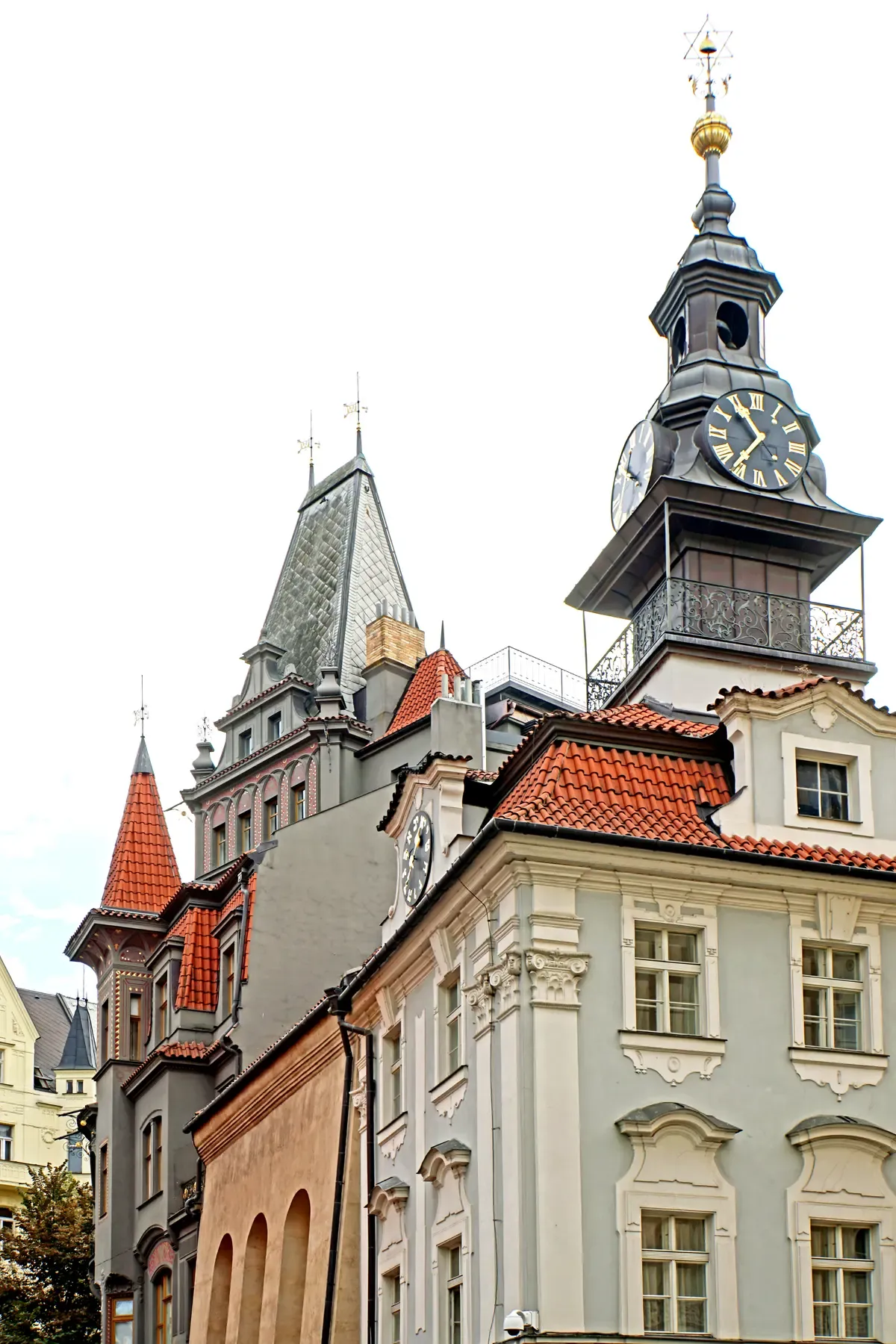
The tower of the Jewish Town Hall in Josefov. Photo: Dennis G. Jarvis, CC BY-SA 2.0, via Wikimedia Commons
Jewish Life in Josefov Today
Josefov is not a museum piece. The Jewish Community of Prague still has its office here and holds Orthodox services in the High Synagogue.
The Jewish Community of Prague
The Jewish Community of Prague has its office at the Jewish Town Hall, Maiselova 250/18, 110 01 Prague 1. It is led by chairman Pavel Král and Chief Rabbi David Peter. Its stated aim is to ensure the religious and cultural life of its members, and it runs a Judaica instruction programme with published schedules. The community also operates the Chevra Kadisha burial society, a library, the EZRA home-care programme and the Hagibor care facility. The rabbinate handles kashrut certification and maintains a mikveh.
The numbers behind this community tell a hard story. Prague had over 92,000 Jewish residents in 1939, nearly 20 percent of the city. At least two-thirds perished in the Holocaust. The count stood at 10,338 in 1946, and roughly 3,400 people left after the 1968 invasion. Current estimates put Prague's Jewish population at about 1,600.
The High Synagogue and Active Worship
The High Synagogue on Červená Street, on the first floor of the Jewish Town Hall, is the community's chapel for Orthodox services. It was built in 1568 with money from Mordechai Maisel, held its last prewar worship in 1941, and after restoration in 1994-1996 services resumed in 1997. The Old-New Synagogue also remains a working house of prayer, which is why it usually closes an hour before Shabbat and stays shut on Jewish holidays.
The Shalom Restaurant
The community runs the Shalom kosher restaurant and shop, the only kosher venue named on the community's own site. Its opening hours are not stated there. The rabbinate can be reached on +420 224 800 849 and the main community office on +420 224 800 812-13 for current kosher listings.
Planning a Visit
One ticket covers the whole circuit, but the closures and the rules catch people out. Here is what you need before you go.
The Ticket
The museum sells the circuit as the Jewish Quarter Ticket, one ticket for all currently open sites: five synagogues and the Old Jewish Cemetery. The Old-New Synagogue has had no separate ticket since the start of 2024 and is part of the unified circuit. For individuals and families the ticket is valid for three opening days, and each site can be entered only once per ticket. Children up to 6 enter free. Tickets are non-refundable and a lost ticket is not replaced.
You can buy it online from the museum e-shop, at the counters of the Spanish, Klausen, Pinkas and Maisel Synagogues, or at the Visitor Centre at Maiselova 15. Sales end 30 minutes before closing. The museum puts a complete visit at roughly 2-3 hours, and the official guided tour lasts 2.5 hours over six sites. Prague Jewish Quarter tours compare the guided options that include entry, so check the homepage comparison if you want a guide rather than going alone.
Hours, Saturdays and Holidays
The museum is open daily except Saturdays and Jewish holidays. The 2026 hours are 9:00-16:30 from early January to late March, 9:00-18:00 in April, 9:00-19:00 from May to the end of August, 9:00-18:00 from September to mid-October, and 9:00-16:30 for the rest of the year. On 1 January it opens 11:00-16:30 and on 24 December it closes at 14:00. Staff start ushering visitors out 10 minutes before closing.
Closed Jewish holidays include the spring festivals in early April and late May and the autumn holidays in September and early October. The museum page lists no closure dates after early October, so later holiday dates are not published yet. Temporary changes are announced at least 24 hours ahead on the museum website.
| Season | Opening hours |
|---|---|
| Early January to late March | 9:00-16:30 |
| April | 9:00-18:00 |
| May to end of August | 9:00-19:00 |
| September to mid-October | 9:00-18:00 |
| Mid-October to end of year | 9:00-16:30 |
Bags, Dress and Conduct
Security checks are required at every entrance, and bags over 30 litres are refused. The museum has no luggage storage. Exposed arms, shoulders or midriff, swimwear and bare feet are not allowed. Men cover their heads in the Old Jewish Cemetery, and visitors may walk only the marked route there. Loud conversation and commentary are not allowed inside the Pinkas Synagogue, which is a memorial.
Food, drinks, ice cream and smoking are banned in all visitor areas, and dogs are banned except certified assistance dogs. Children under 15 must be accompanied by an adult. Personal photos and video are allowed without tripod, selfie stick or flash. The museum advises avoiding the 11:00-15:00 peak, since mornings and late afternoons are much quieter.
Where to Stay Near the Jewish Quarter
Each link opens the live room list for that area on the booking site, with today's prices. Josefov and the Old Town are both in Prague 1, Malá Strana sits across Charles Bridge, and the New Town is the side of the Jerusalem Synagogue.
Josefov
- Suits
- Early entry at the synagogues before the 11:00-15:00 peak
Josefov lies inside Prague 1 with Staré Město.
See stays in Josefov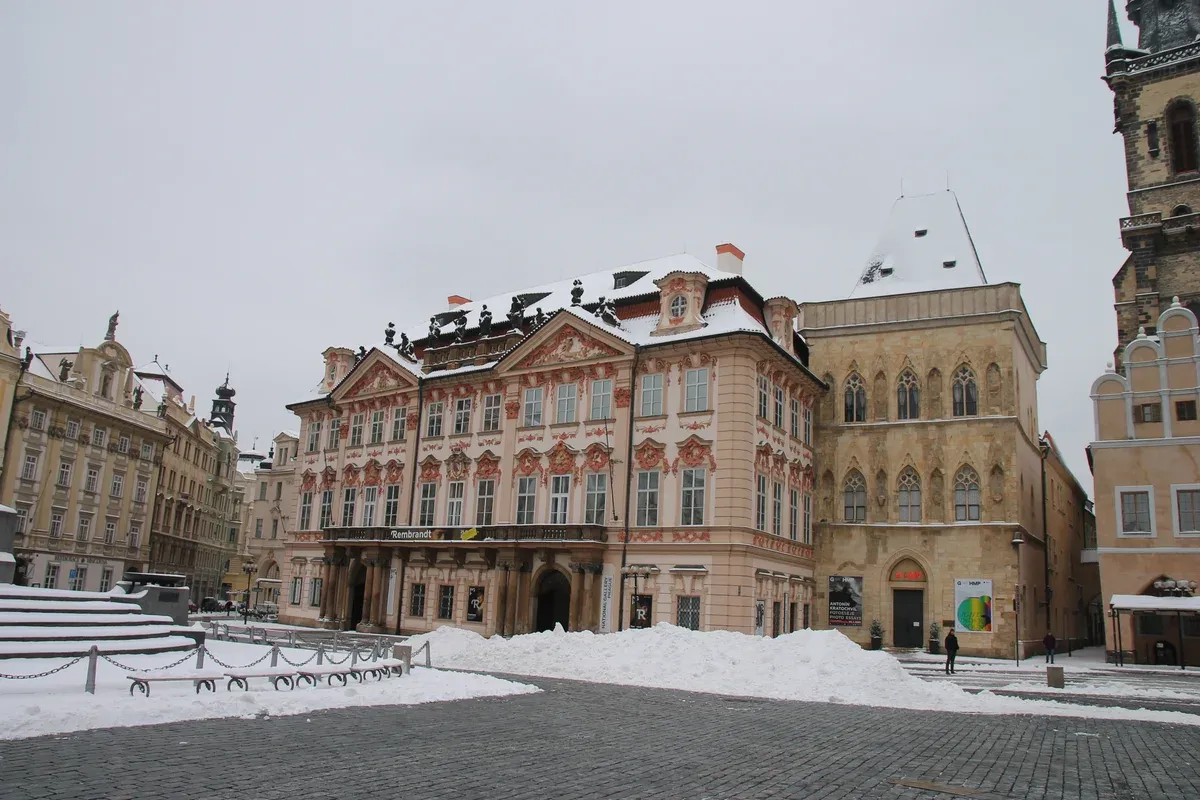
Old Town (Staré Město)
- Suits
- Walks that meet on Old Town Square or at the Old Town Hall
Old Town Square is a few minutes' walk from Josefov.
See stays in Old Town (Staré Město)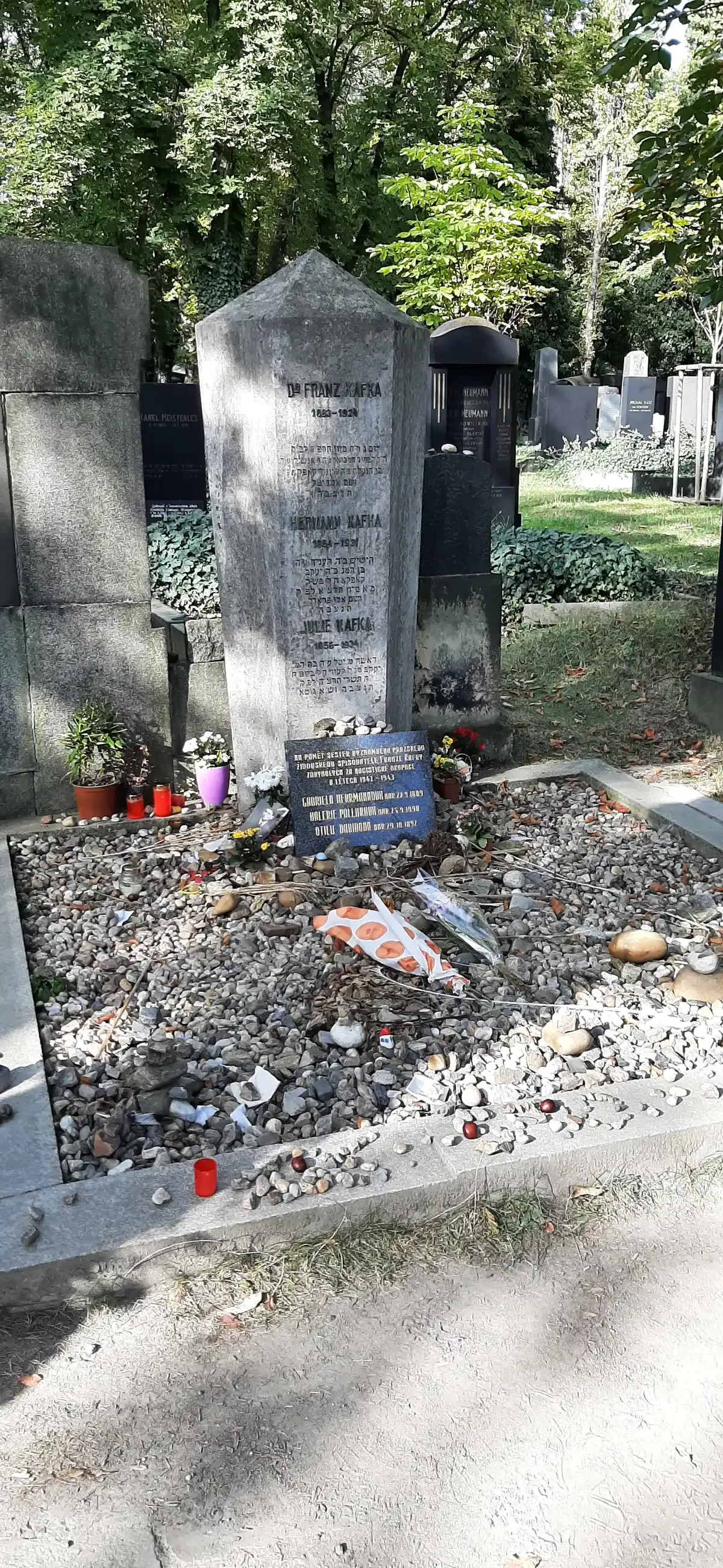
Malá Strana
- Suits
- Prague Castle and the Kafka Museum
Malá Strana is connected to the Old Town by Charles Bridge.
See stays in Malá Strana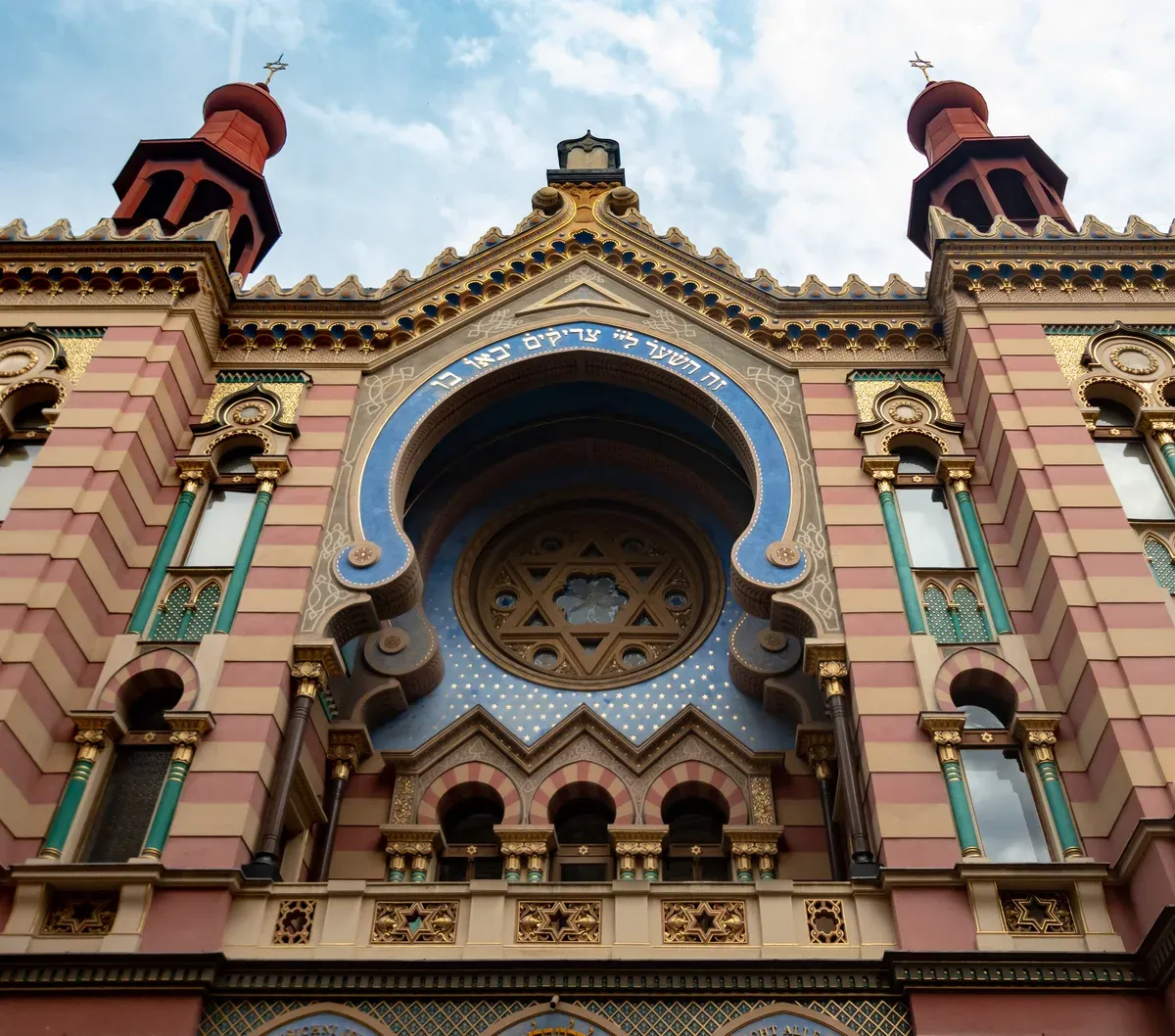
New Town (Nové Město)
- Suits
- The Jerusalem Synagogue and the walk that starts on Wenceslas Square
The Jerusalem Synagogue's nearest tram stop is Jindřišská.
See stays in New Town (Nové Město)Frequently Asked Questions
Is the Jewish Quarter in Prague free to enter?
The streets themselves are free to walk, and the Kafka statue on Dušní costs nothing to see. Entering the synagogues and the Old Jewish Cemetery requires the circuit ticket, which also covers the Old-New Synagogue.
How long does it take to see the Jewish Quarter?
The museum puts a complete visit of all sites at roughly 2-3 hours, and each site can be entered only once per ticket. The official guided tour lasts 2.5 hours. See the planning section for the full details.
Is the Jewish Quarter closed on Saturdays?
Yes. The Jewish Museum is closed every Saturday and on Jewish holidays, and the Old-New Synagogue usually closes an hour before Shabbat begins. Plan your visit for a weekday.
How do I get to the Jewish Quarter?
Staroměstská on Metro Line A is a 3-minute walk from the museum sites, and trams 17 and 18 stop there too. Old Town Square is 5 minutes away on foot and Charles Bridge is 10.
What should I wear in the synagogues?
Exposed arms, shoulders or midriff, swimwear and bare feet are not allowed, and men cover their heads in the Old Jewish Cemetery, with a borrowed covering available. More rules are on the Pinkas Synagogue page, where quiet conduct is required.
Can I visit the Jewish Quarter without a tour?
Yes. One circuit ticket covers all open sites, the audio guide runs about two hours with 80 stops in six languages, and everything sits within a few minutes' walk. If you would rather have a guide, the homepage comparison shows the bookable options.